
Who
AlignSA founders and team, with Dev4Ø4 as end-to-end delivery partner.
Case study for Brand, PR, and Marketing Operations Platform
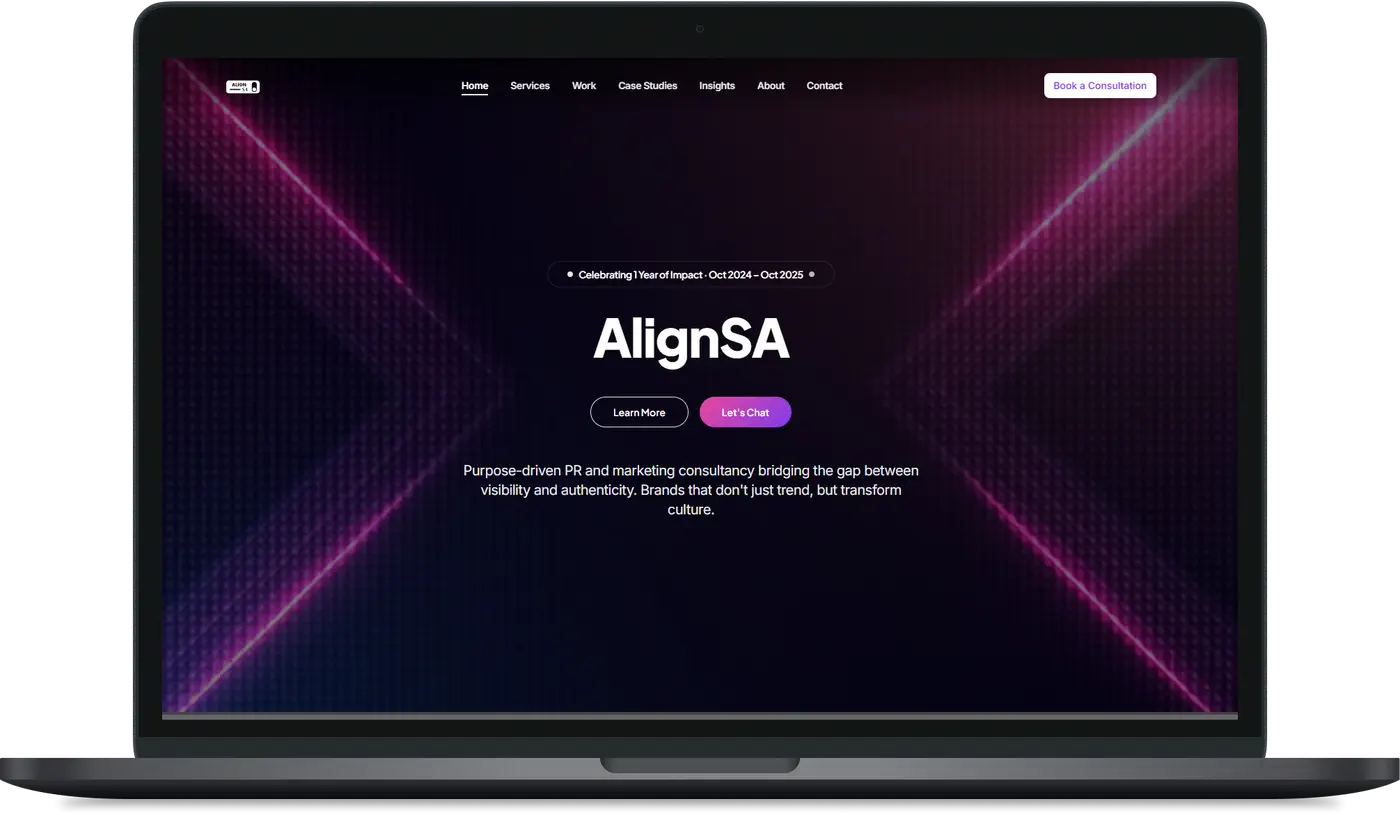
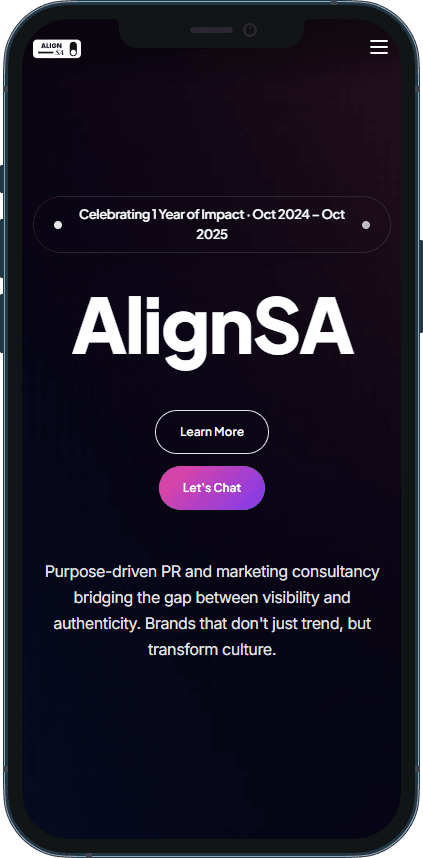
AlignSA was delivered as a full growth and operations platform: a public brand and conversion website, paired with a secure founders console for newsletters, bookings, and insights publishing.
This is the shortest useful read on the project.
Who
AlignSA founders and team, with Dev4Ø4 as end-to-end delivery partner.
What
A multi-route marketing platform plus a private operational console under /founders.
What Changed
The project moved from brochure-style presence to an integrated growth and execution system.
The work had to hold publicly, technically, and operationally.
The project is useful as proof when the context, implementation and handover decisions stay connected.
The problem
AlignSA needed a platform that built trust publicly and reduced the manual load on founders managing bookings, newsletters, and editorial publishing.
Our role
Dev4Ø4 delivered the full product layer, from design system and frontend engineering through API integration, QA, and deployment readiness.
System decision
We implemented a conversion-first public web platform and a private founders workspace that centralises operational workflows. Within 30 days of launch, the platform delivered an estimated 92% increase in qualified leads and reduced founder admin by around 7 hours per week through centralised bookings, newsletters, and insights.
Quality and handover
The build follows reduced-motion support, keyboard-friendly patterns, and measurable performance baselines for ongoing optimisation. Centralised data modules and clear API boundaries make future iteration safer and easier to transfer between teams.
The architecture notes stay at the level supported by the project dossier.
React 18, TypeScript, and Vite were used to ship a token-driven interface with controlled motion and accessibility defaults.
A PHP and MySQL backend supports public conversion flows and private founder operations without external CMS dependency.
Discoverability and quality were treated as product features from day one, not as post-launch patches.
These evidence notes point to the project surfaces that made the delivery legible and maintainable.
Key technical surfaces used to deliver and sustain the platform.
Routing and IA
Public route architecture and lazy-loading were structured for storytelling and conversion flow continuity.
Founders Workspace
Operational console capabilities include newsletters, insights, and booking management.
API Boundary
Public and admin endpoint separation supports safer long-term maintenance.
Discoverability and trust signals were baked into delivery.
Structured Metadata
JSON-LD and route-level SEO controls cover capabilities, insights, and legal pages.
Accessibility Defaults
Semantic structure, keyboard navigation, and reduced motion handling were prioritised.
Automated Checks
E2E and CI checks reduce regression risk before release.
Only signals that help a buyer understand what improved and why it matters stay on the page.
Generated Sitemap URLs
29
Search engines can reliably discover the full public footprint without manual indexing gaps.
As of 23 February 2026
Lighthouse Performance Baseline
67
This baseline highlights where speed improvements can directly improve conversion and retention.
As of 16 January 2026
Lighthouse Accessibility Baseline
94
A strong accessibility baseline protects usability across keyboard, assistive tech, and low-vision scenarios.
As of 16 January 2026
LCP Baseline
10.2s
This identifies image-heavy bottlenecks that can delay first meaningful impression for new visitors.
As of 16 January 2026
Expand the internal insights catalogue to strengthen ongoing authority signals.
Start with the assessmentIf the shape is still unclear, start with the assessment. If the brief is already firm, use the project enquiry instead.
The point is to get the scope clearer before the project becomes expensive to steer.